 Radio Free Earth
Radio Free Earth
Radio Free Earth
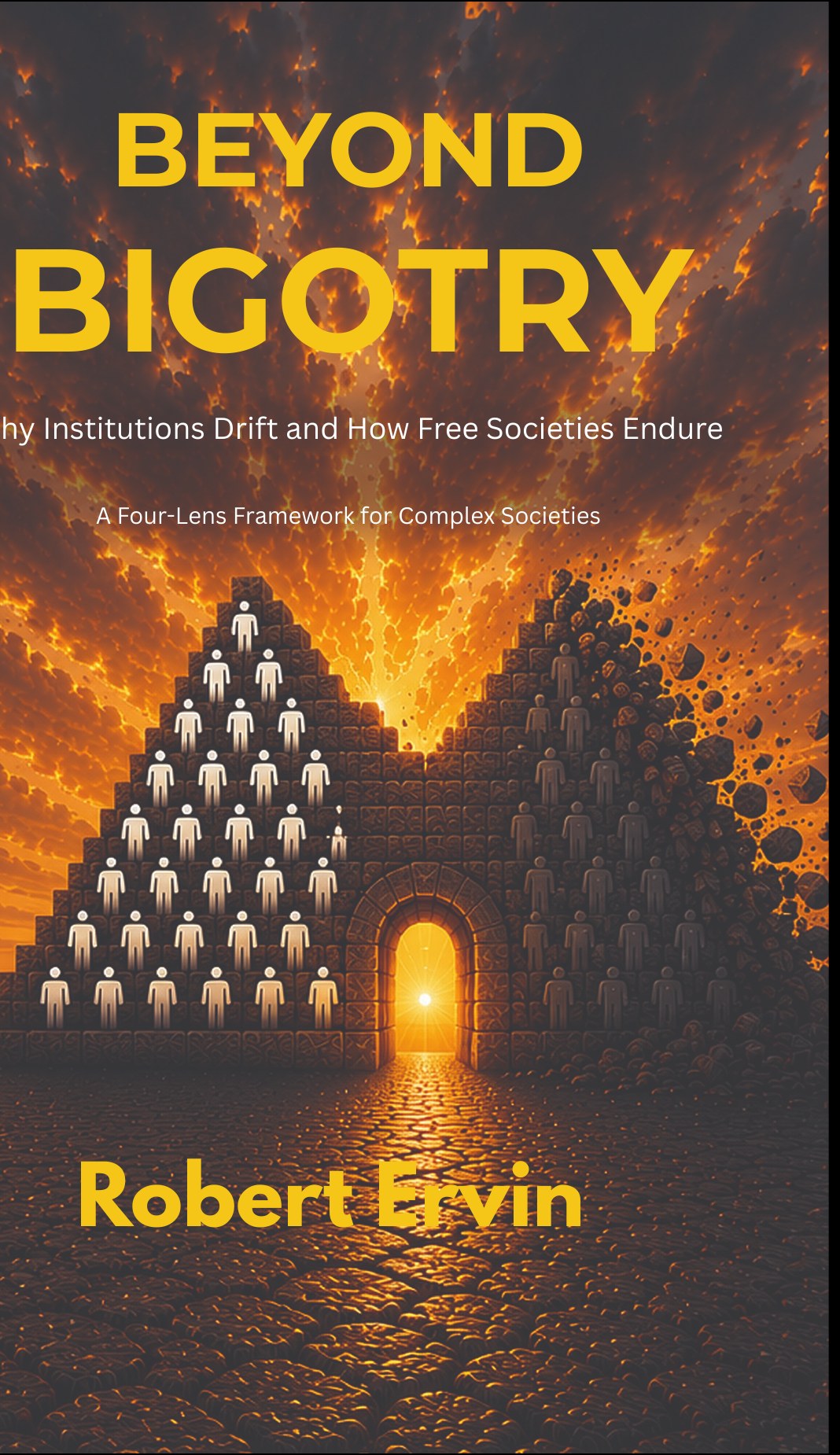
In Beyond Bigotry, Robert Ervin introduces the Four-Lens Framework — a practical method for examining how societies distribute risk, accountability, incentives, and opportunity.
Rather than assigning blame or advancing ideology, the framework evaluates institutional systems through four recurring structural questions — the load-bearing piers of the argument.
How are risks distributed across populations when systems succeed or fail?
To what degree are decision-makers exposed to the consequences of their decisions?
Do institutional incentives reinforce long-term stability, or reward short-term concentration of advantage?
Do systems preserve pathways of movement across social and economic tiers, or restrict participation?
The framework begins with a presumption of Co-Equal Presumption — the idea that all persons possess equal moral standing prior to identity, status, wealth, or belief. Every chapter that follows asks an architectural question, not a moral one: if that is what we know, how did our institutions come to be built as though we didn't?
Why Institutions Drift and How Free Societies Endure
Drawing on history, law, economics, technology, and personal experience, Robert Ervin explores the structural patterns that shape institutions across cultures and generations — from structural drift to pluralist stability.
This book challenges readers to examine the systems around them, and the choices that determine whether those systems endure.
This book began before I knew I was writing it. It began on a highway in Minnesota, when I was very young. A car fleeing the police hit ours. My stepfather, Errol — tall, athletic, a man who had played professional basketball before most leagues would have him — pulled me onto the hood of the car and tried to wipe the blood out of my eyes. A camera crew arrived. One of them kept flashing lights directly into my face. Errol asked them to stop. When they didn't, he moved the cameraman aside. He did not shove him. He moved him.
I have thought about that moment many times in the years since. Not with bitterness — Errol didn't raise me toward bitterness — but with a kind of structural curiosity. What I witnessed was not hatred. It was something quieter, and in some ways harder to name: a system of assumptions so deeply embedded that people acted on them without ever noticing they had a choice.
These experiences did not produce a polemic. They produced questions. Why does bigotry persist even when most people reject injustice? What has always been sacred, and what required the sacred to be violated? This book is an attempt to answer those questions — architecturally, not ideologically.
Beyond Bigotry is the first release from Radio Free Earth — alongside a YouTube channel and an ongoing written series, The Progress Report.
Video conversations and commentary applying the Four-Lens Framework to current events and institutions.
Coming soon →An ongoing written series tracking institutional drift and structural stability, in the spirit of the book.
Coming soon →Be first to know when the book, channel, and newsletter go live.
Email us →Beyond Bigotry is where the Four-Lens Framework gets applied in full. The mission is bigger than the book: teaching people to ask these four questions of any institution, not just this one.
See the full mission →